



What Is Performance Marketing?
Performance marketing is a marketing method where advertising or marketing efforts are measured based on real results. This approach allows businesses to focus on directly measurable outcomes to achieve specific goals.
Payment is typically made when a specific action occurs. For example, the action could be clicking on an ad, making a purchase, or filling out a registration form.
Advantages of Performance Marketing

1. Measurability and Real-Time Analysis
Performance marketing offers a more measurable approach compared to other traditional marketing methods. Metrics such as cost-per-click, cost-per-acquisition, and cost-per-impression can be calculated quickly. We monitor behaviors on digital platforms in real-time, analyze campaign performance, and develop strategies accordingly. This enables us to use the budget more efficiently and achieve better results.
2. Reaching a More Targeted Audience
Performance marketing allows you to better understand your target audience and create customized campaigns for them. After significant data is collected in the ad account, we focus on demographic characteristics or interests. Understanding the behaviors of the main audience helps improve conversions. You can read the article at the link for effective target audience analysis and examples.
3. Cost-Effectiveness
Performance marketing provides flexibility to pay only when a specific action is completed. This allows you to better control your budget and ensures that advertising expenses are based on real results. Similar to traditional marketing methods, you can quickly measure the return on investment of advertising campaigns without wasting your marketing budget.
4. Growth Opportunities
Performance marketing offers significant opportunities to support the growth of your business. For example, through affiliate marketing, you can collaborate with influencers and other businesses to reach new customers. Additionally, by increasing the visibility of your website through search engine optimization (SEO). You support the growth of your brand.
Optimization Methods in Performance Marketing
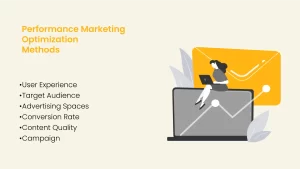
User Experience Optimization
User experience optimization aims to improve the experience users have when using your website or other digital assets. A good user experience can help users spend more time on your site and increase conversion rates.
- User-Friendly Design: It is important for your website or application to have a user-friendly design. Meet users’ needs by providing easy navigation, understandable content, and user-centered layouts.
- Fast Loading Time: This is critical. Pages loading quickly is a very important factor in Google. Optimize images, use caching, or compress unnecessary code. to test website speed Google Page Speed veyaGTmetrix araçlarını kullanın.
- Responsive Design: About 70% of traffic comes from mobile devices according to data. Make sure to check how your website looks on mobile devices.
- User Feedback: Collect user feedback and make improvements based on this feedback. You can gather user opinions through surveys, comments, or user tests.
Target Audience Optimization
An area that should absolutely not be overlooked and carefully crafted! Speaking the language of your target audience in your ads is truly an art.
Speaking in the Language of the Target Audience: Ads that address their problems and meet their needs always win. As a marketer, you must understand the emotions, thoughts, and needs of your target audience. Empathizing and seeing the world through their eyes, putting yourself in their shoes, is the key to successful target audience optimization.
Segmentation: Instead of viewing your target audience as one large group, it’s important to divide them into smaller and more specialized groups. This allows you to create more effective and personalized marketing strategies for each group.
Impact of Visuals: A picture can speak a thousand words. Choose visuals that will resonate with your audience.
Advertising Placement Optimization
Advertising placement refers to where and how your ads appear. Advertising in the right place, at the right time, and in the right way greatly influences the success of your campaign.
Strategic Positioning: It’s important to display your ads on platforms and content where your target audience spends the most time. For example, should your ads be in the Instagram feed or on Google search results pages? Or perhaps on the YouTube masthead?
Alignment of Ad Space with Content: Have you ever seen a horizontal image or video go viral on Instagram? The chances are very low. Therefore, content production and alignment with each channel are important.
CTR (Click-Through Rate) Optimization
Click-through rate is the ratio of clicks to impressions of a directed site. A high CTR indicates that your ads are found interesting by users and have a high potential for clicks.
For CTR optimization:
- Title and Description Optimization: Make your ad titles and descriptions compelling. Attention-grabbing headlines can increase the likelihood of users clicking on your ads. After writing the title, think, “Would I click on this title”
- Relevance to Target Audience: Optimize your ads based on the interests and needs of your target audience. Clear answers to what interests users increase the click-through rate.
- Visual Elements: We definitely check the CTR to understand if an image or video is working well or not. Visuals should encourage interaction with the audience, making them think, “There’s something for me here.”
Conversion Rate Optimization
First, what is conversion? Let’s look at this. Conversion is the completion of a desired action. If the goal action is a purchase, 1 conversion = 1 purchase.
The conversion rate is calculated as users performing the target action according to clicks.
For conversion rate optimization:
- User Journey Analysis: Determine where users are looking when they enter the site. Identify where users are getting lost on which pages or where they are experiencing problems in which steps, and make improvements.
- Simple and Short Forms (If the goal is to fill out a form): Try to keep your conversion forms simple and short for users. Make it easier for users to fill out the form by removing unnecessary fields and reducing mandatory fields.
- Optimization of Payment Page and Button: No one buys anything if they don’t trust. If there is a lot of adding to cart but little conversion, go back to your payment page. Elements such as references, customer reviews, or credibility badges convince the purchase.
Quality of Content
Users pay attention to the quality and relevance of the content they see in search results or ads after clicking.
- Content Optimization: Pay attention to creating high-quality and valuable content on your website or blog. Informative and solution-focused content that meets user needs can encourage users to visit your site and make conversions.
- Keyword Research: There are many marketing tools for keyword analysis. Use these tools to identify the search terms and keywords of your target audience. Optimize content by focusing on these terms.
- Relevance to the Interests of the Target Audience: Organize content according to the interests and needs of your target audience. Displaying content related to topics that interest users increases the conversion rate.
Campaign Optimization
Campaign optimization includes various methods to make advertising campaigns more effective and make the best use of the budget.
- Data Analysis: The outputs of advertising campaign performance guide marketing strategies. Determine which types of ads produce the best results. Gradually increase and decrease the campaign budget based on which one performs better.
- A/B Tests: Conduct A/B tests to test different ad variations. We have many areas where we do tests. For example, message of the campaign, visuals, auction strategy, and so on. Every account’s learning phrase is different.
- Evaluation of Feedback: Optimize your campaigns by considering user feedback. Especially in e-commerce sites, you can quickly get comments. Update ads or goals based on user reactions.
- Continuous Improvement: Continuously monitor your campaigns and make improvements. Update ad texts, analyze audience reactions, and try new strategies to improve performance.
Optimization is something performance marketers do every day. The areas we pay attention to when managing social media ads or Google Ads are basically like this in their most basic form.
Key Metrics Used in Performance Marketing
Performance marketing utilizes various metrics to measure and optimize the effectiveness of digital marketing strategies. These metrics are crucial for evaluating the performance of advertising campaigns, reaching the target audience, and increasing conversions.
- Click-Through Rate (CTR): Click-through rate measures how many clicks an ad or link receives each time it is displayed. A high CTR indicates that the ad is engaging to the target audience and has a high potential for interaction. Factors such as title, description, and visuals play a significant role in determining CTR success.
- Conversion Rate (CR): Conversion rate measures the number of visitors who complete a targeted action, such as making a purchase, filling out a form, or subscribing, through an ad or campaign. High conversion rates indicate the effectiveness of advertising campaigns.
- Cost Per Click (CPC): Cost per click measures the cost of each click on an ad. It helps advertisers understand how much each click costs and effectively manage their advertising budgets. Low CPC values indicate the cost-effectiveness of advertising campaigns.
- Cost Per Acquisition (CPA): Cost per acquisition measures the average cost spent to obtain a conversion. This metric is used to evaluate the conversion efficiency of advertising campaigns and optimize advertising budgets. Low CPA values indicate the effectiveness of advertising campaigns.
- Bounce Rate and Page Views: The average bounce rate and page views of website or app visitors indicate how long users stay engaged with the content and which pages are of interest. These metrics are important for evaluating content performance and improving user experience.